Remote collection of utility meter data without physical access or visual inspection — supporting electricity, water, and gas utilities through RF, PLC, telephone, satellite, and cable communication networks.
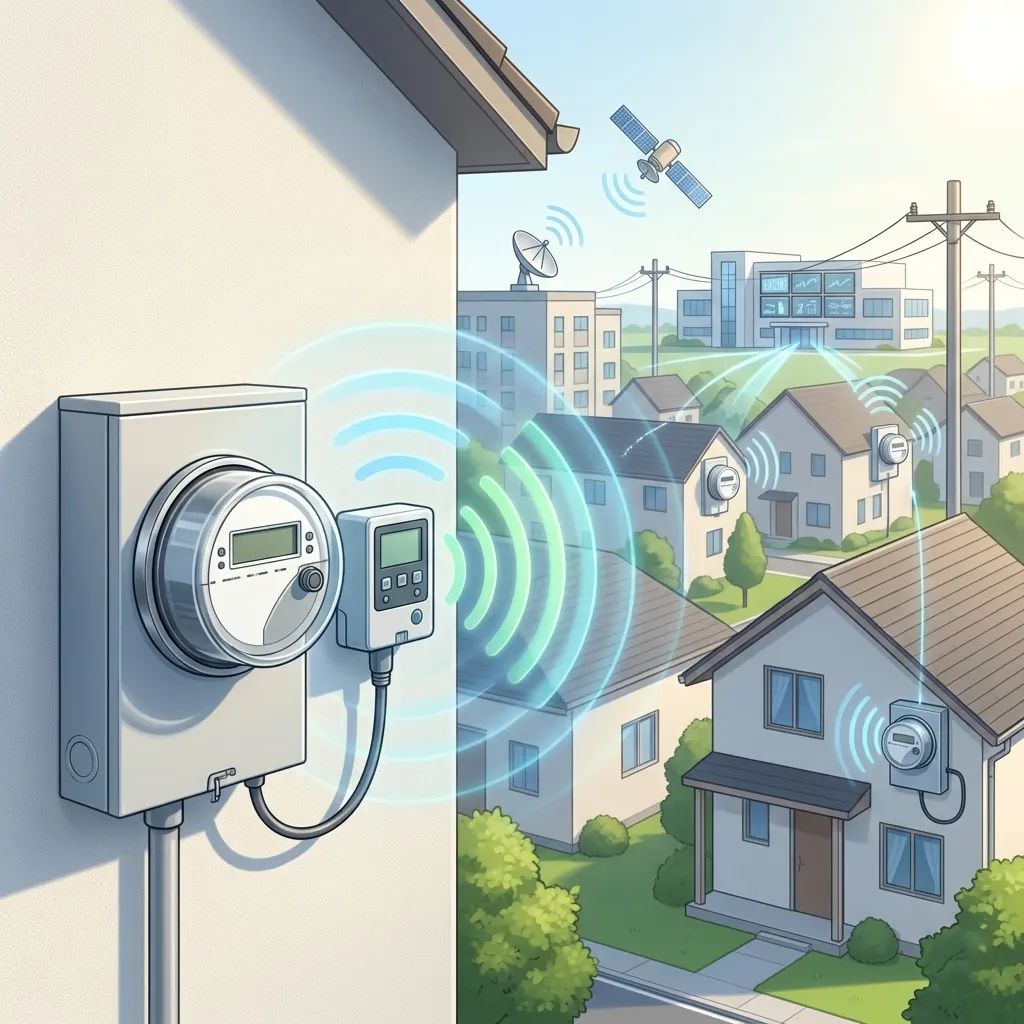
Automatic Meter Reading (AMR) is the reading of a utility meter by a means that does not require physical access or visual inspection of the meter. Rather than sending field staff to each consumer location, AMR systems collect meter data remotely — through radio frequency, telephone, power line, satellite, or cable communication networks.
Within an AMR system, meter data passes from the meter to a Meter Interface Unit (MIU) — which may be external to the meter or integrated within the meter body. The MIU stores not just consumption data, but also tamper and alarm conditions, and forms the interface between the meter and the communications network.
The transfer of meter data from the network to the utility may be instantaneous or stored for later transmission to the host computer. Once data is resident within the utility system, meter and consumer information can be shared with billing, operations, and customer service teams — eliminating manual data entry and delays.
AMR System Components
Electricity, water, or gas meter — captures consumption data
Stores meter data, tamper and alarm conditions — interfaces with the network
RF, PLC, telephone, satellite, cable, or WAN — transmits data to the utility
Processes, monitors, and shares data across billing, operations, and customer service
Eight core capabilities that AMR brings to electricity, water, and gas utilities — from eliminating manual visits to enabling tamper detection and scalable deployments.
Eliminates manual meter visits and human errors — data collected remotely without physical access to the meter.
Compatible with electricity, water, and gas meters — a single AMR infrastructure supporting all utility types.
AMR systems store and transmit tamper and alarm conditions from the MIU — enabling utilities to detect unauthorised access and faults.
RF, Power Line Communication (PLC), telephone lines, satellite, and cable — with hybrid models for complete coverage.
Reliable, encrypted communication protocols ensuring data integrity from meter to central server.
Seamless integration with billing and customer service systems — data shared across operations, billing, and CRM from one host system.
Data can be transmitted instantaneously or stored for scheduled batch delivery — depending on network type and utility preference.
Supports small to large-scale deployments — from a single facility to a full utility network with thousands of meters.
Many communication networks have been used for AMR — including modulated radio frequencies (RF), telephone lines, and the electric power line itself. Depending on the network used, information from the MIU may be retrieved via a handheld receiver, a mobile unit such as a van, or a node on a fixed network.
The data from the MIU can be transmitted over telephone, power lines, satellite, cable, and radio frequency (RF). Each method has advantages and disadvantages, as well as specific suitability for different environments.
Many utilities find that no single technology is universally available or viable for all their AMR needs — and that multiple communication technologies are needed to optimise a complete system. IngrOInfo can advise on the right combination for your network.
IngrOInfo's AMR solution is designed for utility and infrastructure sectors where remote meter reading, billing accuracy, and operational efficiency are critical.
Remote reading of electricity meters across large distribution networks — eliminating manual visits and improving billing accuracy and tamper detection.
Automated water meter reading for municipal and regional water supply authorities — with real-time or scheduled data delivery to billing systems.
Remote gas meter data collection with tamper and alarm detection — supporting accurate billing and network safety monitoring.
City-scale AMR deployments for municipal utilities — integrating multiple meter types across electricity, water, and gas networks.
AMR as a core component of smart city metering infrastructure — supporting real-time data, centralised dashboards, and connected utility management.
Automated meter reading for industrial plants and commercial buildings — accurate consumption data without manual inspection visits.
Once meter data is resident in the host computer, it can be shared with any point on the system — from the billing department's central computer to a customer service representative's PC.
The AMR system integrates with your existing utility infrastructure — billing platforms, ERP systems, CRM software, and energy management systems — enabling seamless data flow across operations without manual re-entry or reconciliation.
Meter data fed directly to billing — accurate and timely invoicing without manual reads.
Consumption data integrated with enterprise resource planning systems for operational management.
Customer consumption history and account data accessible to service representatives in real time.
AMR data feeds into energy management platforms for consumption analytics and demand forecasting.
MIU data transmitted via WAN — private data services or public data networks — to the host computer.
Flexible network integration supporting both private utility networks and public data infrastructure.