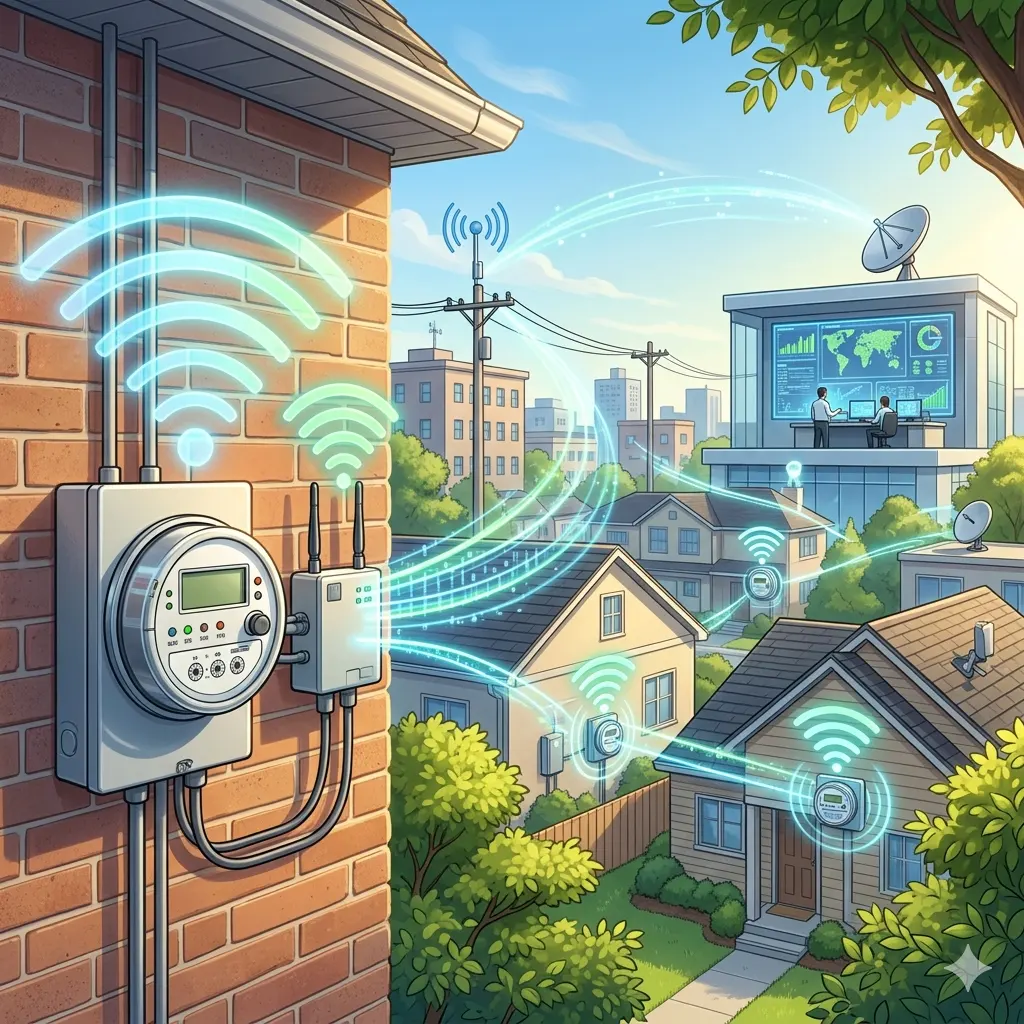
An integrated system of smart meters, communication networks, and data management systems — enabling two-way communication between utilities and customers for automated metering, outage management, tamper detection, and demand response.
Advanced Metering Infrastructure (AMI) is an integrated system of smart meters, communications networks, and data management systems that enables two-way communication between utilities and customers.
The system provides a number of important functions that were not previously possible — or had to be performed manually — such as the ability to automatically and remotely measure electricity use, connect and disconnect service, detect tampering, identify and isolate outages, and monitor voltage.
AMI goes beyond traditional AMR. Where AMR is one-way data collection, AMI establishes a fully bidirectional communication link between the utility and every meter on the network — enabling commands and data to flow in both directions, in real time.
Combined with customer technologies such as in-home displays and programmable communicating thermostats, AMI enables utilities to offer new time-based rate programs and incentives that encourage customers to reduce peak demand and manage their energy consumption and costs.
Remote, scheduled, or real-time electricity consumption data — no manual reads required.
Service activation and deactivation managed remotely — without sending field staff to the premises.
Identifies and reports unauthorised access or meter manipulation to the central system in real time.
Automatically identifies and locates power outages — enabling faster response and restoration.
Continuous voltage level monitoring across the network for improved power quality management.
Each capability represents a function that was previously manual or impossible — now automated through AMI's two-way communication infrastructure.
Enables real-time data exchange between utilities and consumers — commands and consumption data flow in both directions across the AMI network.
Automatically captures and transmits electricity usage data — eliminating manual reads, estimated bills, and the cost of field visits.
Manage service activation and deactivation without field visits — reducing operational costs and improving response times for new connections and disconnections.
Identifies unauthorised access or meter manipulation and transmits tamper alerts to the central system — protecting utility revenue.
Quickly detects, locates, and isolates power outages across the distribution network — enabling faster restoration and reducing customer downtime.
Continuously monitors voltage levels at meter points across the network — supporting power quality management and regulatory compliance.
Supports time-of-use tariffs, demand response programs, and dynamic pricing models — helping utilities manage peak demand and customers reduce energy costs.
Smart meters, communication network, MDAS, and MDMS — all four components working as one.
Intelligent meters that capture real-time consumption data and support two-way communication — enabling remote commands and automated data transmission.
Collects and transfers data from field meters and IoT devices to central management systems — the data aggregation layer of the AMI stack.
Secure and reliable network infrastructure enabling two-way communication between smart meters in the field and central systems — the backbone of the AMI system.
Stores, validates, analyses, and manages large volumes of metering data — feeding billing, operations, customer service, and energy management platforms.

Combined with customer-side devices, AMI enables utilities to offer time-based rate programs and incentives — encouraging customers to reduce peak demand and take control of their energy consumption and costs.
Time-based rate incentives shift consumption away from peak periods — reducing grid stress and infrastructure costs.
In-home displays give customers real-time visibility of their consumption and costs — enabling informed decisions.
Dynamic pricing and demand response programs help customers reduce their electricity bills through smarter usage patterns.
AMI enables time-of-use tariffs and new rate structures that were not possible with traditional metering infrastructure.
AMI is purpose-built for the electricity sector — enabling utilities, boards, and smart grid projects to modernise metering infrastructure and transition to automated operations.
Full AMI deployment for electricity distribution utilities — remote reading, tamper detection, outage management, and voltage monitoring across the distribution network.
State and regional electricity boards transitioning from manual metering to fully automated AMI infrastructure — with remote connect/disconnect and real-time data.
AMI as the metering and communication layer of smart grid deployments — enabling the bidirectional data flows that smart grid operations require.
MDMS and data analytics integration for energy management providers — with granular consumption data supporting demand forecasting and energy optimisation.
City-scale AMI implementations for municipal electricity authorities — with time-based rate programs, demand response, and customer-facing energy management tools.
AMI is specifically designed for electricity utilities — for water and gas metering, see our AMR and Flow Meter services.